How Much Does an NRI Wedding Planner in India Cost?
Planning a wedding in India while living abroad sounds exciting until the real coordination begins.
You may be sitting in New Jersey, London, Toronto, Dubai, Melbourne, or Singapore while trying to compare venues in Jaipur, speak to decorators in Udaipur, coordinate family opinions in India, check vendor availability, understand hotel room blocks, review menus, and manage payments in rupees. That is exactly where an experienced NRI wedding planner in India becomes valuable.
Direct Answer
An NRI wedding planner in India typically costs anywhere from 4 lakh to 15 lakh or more for destination and full-service planning. For luxury, multi-day, heritage, palace, or large-scale weddings in locations such as Udaipur, Jaipur, Jodhpur, Jaisalmer, or Goa, planner fees can go beyond 15 lakh to 25 lakh or more depending on the scope, guest count, number of events, team size, design involvement, and logistics complexity.
Some planners charge a fixed professional fee. Some charge a percentage of the wedding budget. Some use a hybrid model. The right fee structure depends on how much responsibility the planner is taking, how early they are involved, and whether they are handling only coordination or complete planning from venue search to wedding-day execution.
At The Vintage Saga, we recommend that NRI families evaluate planner cost based on scope, transparency, on-ground strength, vendor accountability, and comfort with remote planning, not just the lowest quote.
What Does an NRI Wedding Planner in India Actually Do?
An NRI wedding planner is not just someone who recommends vendors. For overseas couples and families, the planner becomes the local planning office, coordination bridge, budget controller, vendor filter, family communication partner, and execution team in India.
A good wedding planner for NRI weddings in India usually helps with:
| Planning Area | What the Planner Handles |
|---|---|
| Venue booking | Shortlisting, availability checks, site visits, negotiation support, room block coordination |
| Vendor coordination | Décor, photography, catering, entertainment, makeup, mehendi, logistics, invitations, gifting |
| Budgeting | Budget sheet, cost comparison, payment tracking, scope control |
| Décor planning | Mood boards, themes, floral concepts, lighting, stage design, entry concepts |
| Hospitality | Guest arrivals, welcome desks, rooming lists, airport transfers, itinerary support |
| Family coordination | Aligning couple, parents, relatives, and decision-makers across cities and time zones |
| Remote planning | Video calls, shared documents, WhatsApp updates, approval timelines, virtual reviews |
| Wedding execution | Event flow, vendor reporting, timeline control, backstage coordination, emergency handling |
For NRIs, the biggest benefit is not just saving time. It is reducing uncertainty. When you are not physically present in India, you need someone who can verify, negotiate, inspect, and execute on your behalf.
How Much Does an NRI Wedding Planner Cost in India?
For most overseas couples, the cost of hiring an NRI wedding planner in India depends on the service level.
| Service Type | Indicative Planner Fee Range in India | Best For |
|---|---|---|
| Wedding-day or wedding-week coordination | 2 lakh to 5 lakh plus | Families who have booked most vendors but need professional execution |
| Partial planning | 3 lakh to 8 lakh plus | Couples who have selected a venue or some vendors but need help with the rest |
| Full-service NRI wedding planning | 6 lakh to 15 lakh plus | Overseas couples who want end-to-end planning from abroad |
| Destination wedding planning | 8 lakh to 20 lakh plus | Multi-day weddings with venue, hospitality, logistics, décor, and vendor management |
| Luxury or palace wedding planning | 15 lakh to 25 lakh plus or custom | High-budget weddings, large guest counts, premium venues, complex production |
| Ultra-luxury, multi-city, or high-complexity weddings | Custom quote | Large-scale weddings requiring extensive teams and advanced production planning |
These are indicative market ranges. Actual wedding planner fees in India for NRI weddings depend on the planner’s experience, city, wedding size, guest logistics, number of functions, décor involvement, hospitality scope, travel needs, and execution team size.
A two-day wedding for 100 guests at a boutique property will not require the same planning team as a four-day Udaipur palace wedding with 300 guests, multiple hotels, airport pickups, artist management, after-parties, and family events.
Why Are NRI Wedding Planner Fees Different From Regular Wedding Planner Fees?
NRI weddings usually cost more to plan because the planner is solving more than local wedding logistics.
In a local wedding, the family may be available for in-person vendor meetings, tastings, venue visits, payment follow-ups, and last-minute checks. In an NRI wedding, those tasks often shift to the planner.
The planner may need to manage:
- Time-zone-based planning calls
- Remote vendor presentations
- Online budget approvals
- Currency and payment coordination
- Parents and relatives in different countries
- On-ground vendor verification
- Venue visits and recce reports
- Guest travel from multiple countries
- Hotel room blocks and hospitality desks
- Local permissions and venue protocols
- Last-minute family decisions after everyone arrives in India
This is why the cheapest planner is rarely the safest choice for an overseas couple. For an NRI wedding, you are not just hiring planning support. You are hiring local accountability.
Common Wedding Planner Fee Models in India
1. Fixed Professional Fee
This is one of the clearest pricing models. The planner quotes a fixed fee based on scope, guest count, number of events, destination, and services included.
Best for NRIs because it gives cost clarity before planning begins.
Example: A planner may quote 8 lakh for end-to-end planning of a two-day destination wedding in Jaipur with 150 guests.
2. Percentage of Wedding Budget
Some planners charge a percentage of the total wedding budget. This may range widely depending on the planner, scale, and destination.
For large weddings, this model can become expensive. It may work when the planner is deeply involved in design, production, vendor negotiation, budget control, and execution.
Example: If the wedding budget is 1 crore and the planner charges 10%, the planner fee is 10 lakh.
3. Hybrid Fee
A hybrid model combines a base planning fee with a percentage or management fee on selected services. This is common when the wedding scope is evolving or when the planner is also managing production-heavy elements.
NRIs should ask for complete clarity on what is included and what is charged separately.
4. Vendor Commission Model
Some planners may earn commissions from vendors. This is not automatically wrong, but it must be disclosed. The risk for overseas families is that vendor recommendations may become less transparent if the planner’s income depends heavily on commissions.
Ask directly: “Do you charge us only a professional fee, or do you also earn from vendors?”
5. Package-Based Fee
Some planners offer packages such as coordination-only, partial planning, full planning, or destination wedding management. Packages are useful for comparison, but the inclusions must be reviewed carefully.
Do not compare two planner quotes only by price. Compare the scope line by line.
What Is Included in an NRI Wedding Planner’s Fee?
A full-service NRI destination wedding planner in India may include the following:
Venue Shortlisting and Booking Support
The planner helps you choose destinations, compare venue categories, check capacity, evaluate rooms, understand food and beverage minimums, review event spaces, and coordinate availability.
For Rajasthan weddings, this is especially important because heritage hotels, forts, palaces, luxury resorts, lakeside properties, and desert venues all have different rules.
Vendor Vetting and Coordination
The planner shortlists and coordinates decorators, photographers, caterers, makeup artists, mehendi artists, entertainers, DJs, priests, choreographers, logistics vendors, invitation designers, gifting partners, and technical production teams.
For NRIs, vendor vetting is critical because Instagram portfolios do not always show reliability, execution discipline, contract clarity, or punctuality.
Wedding Budgeting
A good planner helps create a working budget and updates it as decisions are made. This includes venue, food, décor, entertainment, photography, logistics, hospitality, gifting, licenses, taxes, and contingency amounts.
This is one of the biggest reasons to hire a planner early. Once venue and décor decisions are made without budget control, costs can escalate quickly.
Décor Planning and Design Coordination
Depending on the package, the planner may coordinate décor themes, color palettes, stage design, mandap concepts, floral styling, lighting, seating, tablescapes, signage, and event-wise styling.
Some planners provide design direction. Others coordinate with a separate décor agency. Ask which model applies.
Guest Logistics and Hospitality
For NRI weddings, hospitality is often a major workload. Guests may arrive from several countries and Indian cities. The planner may manage airport pickups, hotel check-ins, welcome hampers, rooming lists, hospitality desks, event transfers, luggage support, and guest itineraries.
Family Coordination
Indian weddings involve many stakeholders. The couple may live abroad, parents may be in India or overseas, and relatives may influence decisions. The planner helps align everyone through structured calls, approvals, and timelines.
This is not a small task. Family coordination can save weeks of confusion.
Time-Zone-Based Remote Planning
A strong NRI wedding planner should have a remote workflow. This may include:
- Scheduled video calls
- Shared planning trackers
- Budget sheets
- Vendor comparison documents
- Décor decks
- Payment calendars
- Approval deadlines
- WhatsApp groups with clear roles
- Meeting summaries after every major call
This process matters because planning cannot depend on scattered late-night phone calls.
Wedding-Day Execution
During the wedding, the planner manages event flow, vendor arrival, setup timelines, décor readiness, guest movement, backstage coordination, family cues, ceremony timing, entertainment transitions, food service coordination, and contingency handling.
This is where planning becomes execution.
What Is Usually Not Included in Planner Fees?
Planner fees usually do not include the actual wedding expenses. These are normally separate:
| Expense | Usually Separate From Planner Fee? |
|---|---|
| Venue rental or hotel buyout | Yes |
| Catering and food packages | Yes |
| Guest rooms | Yes |
| Décor production | Yes |
| Photography and videography | Yes |
| Makeup and styling | Yes |
| Entertainment and artists | Yes |
| Travel and transport | Yes |
| Priest or ceremony specialists | Yes |
| Licenses and permissions | Usually yes |
| Planner team travel and stay | Often yes |
| Taxes | Usually yes |
Before signing, ask for a written scope and a list of exclusions. This prevents unpleasant surprises later.
What Factors Affect the Cost of an NRI Wedding Planner in India?
1. Guest Count
A 70-guest intimate wedding is very different from a 300-guest destination wedding. More guests mean more rooms, transfers, food service coordination, seating plans, welcome kits, RSVP handling, and hospitality staff.
2. Number of Events
A simple wedding ceremony and reception may need limited planning. A full Indian wedding with mehendi, haldi, pool party, sangeet, wedding, reception, after-party, and farewell brunch needs a larger team.
3. Destination
Planner cost may increase for destinations that require travel, multiple site visits, special permissions, heritage venue protocols, or complex guest movement.
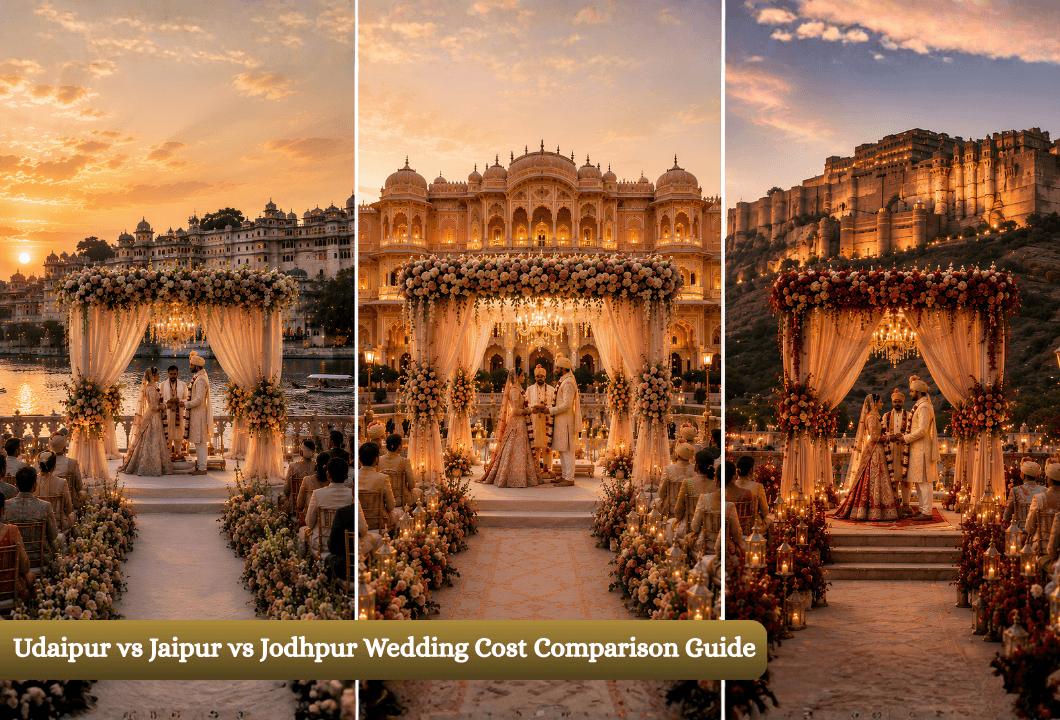
Rajasthan destinations such as Udaipur, Jaipur, Jodhpur, Jaisalmer, Pushkar, Kumbhalgarh, and Sawai Madhopur each require different planning strategies.
4. Venue Type
A city hotel wedding is easier to coordinate than a fort wedding, palace wedding, lakeside wedding, desert wedding, or multi-venue celebration.
Heritage venues may have vendor restrictions, décor limitations, sound rules, access challenges, load-in timelines, or approved vendor lists.
5. Planning Timeline
If you hire a planner 10 to 12 months before the wedding, the team can plan calmly. If you hire someone three months before a peak-season wedding, the workload intensifies.
Late planning often costs more because the planner must compress decisions, negotiate under pressure, and solve availability issues quickly.
6. Level of Design Involvement
If you only need vendor coordination, the planner fee may be lower. If you want bespoke wedding design, theme development, mood boards, artist curation, guest experience planning, and production oversight, the planner fee will be higher.
7. Hospitality Scope
For NRI weddings, hospitality can become a major part of the project. Airport arrivals, rooming lists, guest help desks, welcome hampers, luggage coordination, and transport schedules all require staff and systems.
8. Team Size
A professional wedding execution team may include lead planners, hospitality managers, logistics coordinators, vendor managers, décor supervisors, family coordinators, and event captains.
The more complex the wedding, the larger the team required.
9. Vendor Negotiation and Budget Control
Experienced planners may cost more upfront, but they can help avoid unsuitable vendors, weak contracts, duplicate costs, poor timelines, and last-minute panic buying.
10. Communication Requirements
NRI weddings often require more calls, summaries, documentation, and approvals than local weddings. If multiple family members across countries are involved, coordination time increases.
Wedding Planner Charges for NRI Weddings in Rajasthan
Rajasthan is one of the strongest destination wedding regions in India because it offers heritage hotels, palaces, forts, lakeside venues, desert landscapes, forest resorts, and rich cultural settings.
For overseas couples, Rajasthan is attractive because it delivers the classic Indian wedding experience with a strong sense of place. But it also needs serious planning.
Jaipur
Jaipur works well for NRIs because it has strong connectivity, luxury hotels, heritage venues, and vendor availability. Planner fees may be more controlled compared with very exclusive palace destinations, but costs rise with guest count, décor scale, and peak-season dates.
Best for: accessible royal weddings, large family gatherings, multi-event celebrations.
Udaipur
Udaipur is premium, romantic, and highly sought after. Lakeside venues, palace hotels, and luxury properties often require careful planning around room inventory, guest transfers, venue rules, weather, and décor logistics.
Best for: luxury destination weddings, palace-style celebrations, intimate high-end weddings.
Jodhpur
Jodhpur is bold, royal, and visually dramatic. It suits couples who want fort backdrops, blue-city character, and a regal wedding atmosphere. Logistics can become more complex depending on venue location and guest movement.
Best for: royal-themed weddings, grand sangeets, heritage celebrations.
Jaisalmer
Jaisalmer is ideal for desert weddings, intimate celebrations, cultural evenings, folk performances, and golden sandstone backdrops. It requires careful travel planning because guest arrival logistics can be more layered than Jaipur or Udaipur.
Best for: experiential weddings, desert welcome dinners, intimate destination weddings.
Pushkar and Kumbhalgarh
These destinations are ideal for families who want something scenic, cultural, or slightly offbeat. Planner involvement is important because vendor movement, accommodation choices, and transport planning need early clarity.
Best for: intimate weddings, spiritual settings, private resort celebrations, nature-led experiences.
The Vintage Saga has a Rajasthan-focused destination wedding presence, with services and destination pages covering Jaipur, Udaipur, Jodhpur, Jaisalmer, Kumbhalgarh, Sawai Madhopur, and Pushkar. That local relevance matters for NRI families who cannot personally inspect every venue or vendor.
Is Hiring a Wedding Planner in India Worth It for NRIs?
Yes, for most NRI weddings, hiring a planner in India is worth it if the wedding involves multiple events, destination travel, more than 80 to 100 guests, premium venues, or family members arriving from different cities and countries.
It may not be necessary if you are having a very small wedding at home with only one event and a limited vendor list. But for destination weddings and culturally layered Indian weddings, a planner is usually a practical investment.
What You Are Really Paying For
You are paying for:
- Local presence
- Vendor verification
- Budget discipline
- Reduced family stress
- Better time management
- Guest experience control
- Professional event-day execution
- Fewer last-minute surprises
- One accountable team
For overseas couples, the value is simple: you stay involved in decisions without becoming the full-time project manager.
Fixed Fee vs Percentage Fee: Which Is Better for NRIs?
| Fee Model | Pros | Cons | Best For |
|---|---|---|---|
| Fixed fee | Clear, predictable, easier to budget | Scope must be defined well | Most NRI weddings |
| Percentage fee | Aligns planner fee with wedding scale | Can become expensive as budget grows | High-complexity luxury weddings |
| Hybrid fee | Flexible for evolving scope | Needs transparency | Weddings with changing requirements |
| Commission-led model | May reduce upfront fee | Can create transparency concerns | Only if commission disclosure is clear |
| Package fee | Easy to compare | May exclude important services | Couples with simple requirements |
For NRI families, fixed fee or transparent hybrid pricing is usually easier to manage because it reduces confusion and makes budget planning more predictable.
How Can NRIs Avoid Overpaying for a Wedding Planner in India?
1. Ask for a Scope Sheet
Do not accept a vague proposal. Ask for a written scope that clearly lists planning, coordination, hospitality, décor, logistics, vendor management, and execution responsibilities.
2. Compare Inclusions, Not Just Fees
One planner may quote 5 lakh and include only coordination. Another may quote 9 lakh and include venue support, vendor shortlisting, budget management, décor coordination, hospitality planning, family calls, and wedding-day execution.
The second quote may be better value.
3. Ask About Vendor Commissions
Ask directly whether the planner earns from vendors. Transparency matters more than the model itself.
4. Check On-Ground Strength
For destination weddings, ask who will be physically present during site visits and wedding days. A planner without a strong execution team can struggle during a multi-event wedding.
5. Review Payment Milestones
Avoid paying the entire fee upfront. Payment milestones should be linked to planning phases.
6. Ask for a Planning Timeline
A professional planner should be able to show how the next six to twelve months will unfold.
7. Check Regional Experience
If you are planning a Rajasthan destination wedding, hire someone who understands Rajasthan venues, guest movement, local vendors, weather patterns, heritage property rules, and hospitality expectations.
8. Be Clear About Decision-Makers
If the couple, parents, and siblings are all involved, define who approves what. Too many informal decision-makers can create delays and budget confusion.
How to Hire a Wedding Planner in India From Abroad
Use this process before finalizing a planner.
Step 1: Define Your Wedding Basics
Prepare these details:
- Preferred city or destination
- Approximate guest count
- Number of events
- Wedding month or date range
- Approximate total budget
- Décor expectations
- Guest travel needs
- Whether parents are in India or abroad
- Level of planner involvement required
Step 2: Shortlist Planners With Relevant Experience
Look for planners who have handled Indian weddings, destination weddings, and remote planning. If Rajasthan is your focus, check their work in Jaipur, Udaipur, Jodhpur, Jaisalmer, Pushkar, Kumbhalgarh, or nearby locations.
Step 3: Schedule a Discovery Call
Use the call to understand their process, team, pricing model, communication style, and vendor approach.
Step 4: Ask for a Custom Proposal
A good proposal should include:
- Scope of services
- Planner fee
- Exclusions
- Team involvement
- Planning timeline
- Payment structure
- Communication process
- Approximate next steps
Step 5: Compare Proposals Properly
Do not pick only by price. Compare responsiveness, clarity, local knowledge, professionalism, and trust.
Step 6: Sign a Written Agreement
The contract should mention scope, payment terms, cancellation terms, deliverables, exclusions, confidentiality, vendor payment process, and wedding-day responsibilities.
Questions NRIs Should Ask Before Finalizing a Wedding Planner
Ask these before you sign:
- What is your experience with NRI weddings?
- Have you planned weddings in our preferred destination?
- Do you charge a fixed fee, percentage fee, package fee, or hybrid fee?
- Do you earn vendor commissions?
- What is included in your planning fee?
- What is excluded?
- Who from your team will be on-site?
- How do you manage time-zone differences?
- How do you handle family coordination?
- How do you share budgets and vendor comparisons?
- How often will we have planning calls?
- What happens if a vendor fails or cancels?
- How do you manage guest hospitality?
- How early should we arrive in India before the wedding?
- Can you help with venue booking and vendor negotiation?
Red Flags to Watch For
Be careful if a planner:
- Avoids giving a written scope
- Refuses to discuss vendor commissions
- Promises unrealistic discounts
- Pushes one vendor without comparison
- Has no clear planning process
- Cannot explain team structure
- Gives only verbal commitments
- Does not understand your destination
- Has weak communication during inquiry stage
- Quotes a very low fee but excludes major services
A low planner fee can become expensive if the planner cannot manage vendors, guests, timelines, and family expectations properly.
Why The Vintage Saga Is Relevant for NRI Weddings in India
The Vintage Saga is especially relevant for NRI families considering a Rajasthan wedding because the brand focuses on destination wedding planning across major Rajasthan locations. The team’s service areas include venue selection and booking, wedding décor and styling, hospitality and guest management, catering coordination, entertainment and artist management, photography and videography coordination, logistics, transport, scheduling, wedding-day execution, and post-event wrap-up.
For NRIs, this kind of end-to-end planning support matters because you need one accountable team in India. Instead of asking parents or relatives to chase venues and vendors, you can work through a structured planning process with professionals who understand both celebration design and on-ground execution.
If you are planning from abroad, The Vintage Saga can help you evaluate your destination, guest count, budget, wedding style, family requirements, and planning timeline before you start booking major vendors.
Practical Cost Examples
Example 1: Intimate Jaipur Wedding
Guest count: 80 to 100
Events: Mehendi, wedding, reception
Planning need: Venue support, vendor coordination, basic hospitality, execution
Planner fee expectation: 4 lakh to 8 lakh plus
Example 2: Udaipur Destination Wedding
Guest count: 150 to 200
Events: Welcome dinner, mehendi, sangeet, wedding, reception
Planning need: Venue booking, décor coordination, hospitality, guest transfers, vendor management, wedding-day execution
Planner fee expectation: 8 lakh to 18 lakh plus
Example 3: Luxury Rajasthan Palace Wedding
Guest count: 250 to 350
Events: Multiple family events, welcome party, haldi, mehendi, sangeet, wedding, reception, after-party
Planning need: Full-service planning, design coordination, hospitality desk, logistics, artist management, high-touch family coordination, large execution team
Planner fee expectation: 15 lakh to 25 lakh plus or custom
These examples are indicative. The actual quote depends on scope, destination, venue, timeline, and planning complexity.
When Should NRIs Hire a Wedding Planner in India?
Ideally, hire your planner 9 to 12 months before the wedding. For peak-season Rajasthan weddings between October and March, start even earlier if you want premium venues or specific dates.
If your timeline is shorter, hire the planner before you confirm too many vendors. A planner can help you avoid mismatched contracts, unrealistic décor estimates, poor room-block decisions, and rushed vendor commitments.
Final Takeaway
An NRI wedding planner in India usually costs between 4 lakh and 15 lakh or more, with luxury and complex destination weddings often going beyond that range. The right planner fee depends on scope, destination, guest count, number of events, hospitality needs, décor involvement, remote coordination, and execution team size.
For overseas couples, the bigger question is not “Who is the cheapest planner?” The better question is “Who can responsibly plan, verify, coordinate, and execute our wedding in India while we are abroad?”
Planning your wedding in India from abroad? Speak with The Vintage Saga for end-to-end NRI wedding planning, venue booking, vendor coordination, guest logistics, hospitality management, décor planning, and on-ground execution across Rajasthan and other Indian wedding destinations.
FAQs About NRI Wedding Planner Cost in India
1. How much does an NRI wedding planner cost in India?
An NRI wedding planner in India typically costs 4 lakh to 15 lakh or more for partial, full-service, or destination wedding planning. Luxury palace weddings, large guest counts, multi-day events, and complex hospitality can push planner fees above 15 lakh to 25 lakh or custom pricing.
2. What are typical NRI wedding planner fees in India?
Typical NRI wedding planner fees in India depend on scope. Coordination-only services may start around 2 lakh to 5 lakh, partial planning may range from 3 lakh to 8 lakh, and full-service destination wedding planning may range from 6 lakh to 20 lakh or more.
3. Do wedding planners in India charge a fixed fee or percentage?
Both models exist. Many planners charge a fixed professional fee based on scope. Some charge a percentage of the total wedding budget. Others use hybrid or package-based pricing. NRIs should ask for clear written pricing before signing.
4. Is hiring a wedding planner in India worth it for NRIs?
Yes, especially if the wedding has multiple events, a destination venue, 80 or more guests, family members across countries, or significant guest hospitality. A planner helps manage vendor vetting, budgeting, logistics, décor, family coordination, and wedding-day execution.
5. Why do NRI weddings need more planning support?
NRI weddings need more planning support because the couple and family are often coordinating from abroad. Time-zone differences, remote vendor meetings, venue verification, guest travel, hotel blocks, payment coordination, and family approvals require a structured on-ground planning team.
6. What is included in an NRI wedding planner’s fee?
Planner fees may include venue shortlisting, vendor coordination, budget planning, décor coordination, hospitality planning, guest logistics, family coordination, remote planning calls, vendor timelines, and wedding-day execution. Exact inclusions vary by planner and package.
7. What is not included in wedding planner fees?
Planner fees usually do not include venue rental, catering, décor production, guest rooms, photography, makeup, entertainment, travel, transport, licenses, taxes, or vendor payments. Planner team travel and accommodation may also be charged separately.
8. How early should NRIs hire a wedding planner in India?
NRIs should ideally hire a wedding planner 9 to 12 months before the wedding. For peak-season Rajasthan destination weddings in Jaipur, Udaipur, Jodhpur, or Jaisalmer, starting earlier helps with better venue availability and smoother vendor planning.
9. How can NRIs avoid overpaying for a wedding planner?
Ask for a written scope, compare inclusions, clarify vendor commissions, check regional experience, review payment milestones, ask for a planning timeline, and confirm who will be on-site during the wedding.
10. Is a Rajasthan wedding planner better for an NRI destination wedding in Rajasthan?
For Rajasthan weddings, a planner with local experience is highly valuable. Local knowledge helps with venue protocols, vendor availability, guest logistics, transport, hospitality, décor feasibility, and on-ground execution in cities such as Jaipur, Udaipur, Jodhpur, Jaisalmer, Pushkar, and Kumbhalgarh.
11. Can NRIs plan a wedding in India without visiting India?
Yes, but it requires a strong planner, structured remote workflow, video calls, shared planning documents, venue walkthroughs, vendor presentations, and family alignment. Most couples still benefit from at least one India visit before the wedding if possible.
12. Does The Vintage Saga plan NRI weddings in India?
The Vintage Saga offers destination wedding planning, venue booking, vendor coordination, décor planning, hospitality, logistics, and end-to-end execution support across Rajasthan and other Indian wedding destinations. NRI couples can book a consultation to discuss guest count, destination, budget, and planning timeline.